

There’s a particular kind of frustration familiar to anyone who has spent time in local or regional economic development. You’ve spent weeks pulling together the evidence base. You’ve mapped the labour market gaps, modelled the productivity deficit, built the investment case. You’ve consulted the partners, aligned the strategies, and found the match funding. And then you sit in a committee room and find yourself explaining, from first principles, why economic development matters at all.
If that sounds familiar, you’re not alone. And if you think the answer is simply to do better work, the evidence suggests the real challenge runs deeper than that.
The rationale for local and regional economic development — the foundational case for why we intervene, at what level, and to what end — is something practitioners need not just to understand, but to be able to articulate, defend, and refresh throughout their careers.
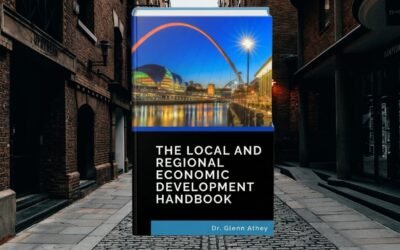
This is one of the central themes running through The Local and Regional Economic Development Handbook, a new comprehensive resource for practitioners, policymakers, and analysts working across the field. The opening chapter on rationale doesn’t treat this as a theoretical preamble. It treats it as one of the most practical skills an economic developer can have.
The Starting Point: Why Do Local and Regional Economies Differ So Much?
The foundational reason that local and regional economic development exists as a distinct discipline — rather than simply being subsumed within national economic policy — is straightforward: places are not equal, and they are not equally affected by economic change.
The UK offers one of the starkest illustrations of this anywhere in the developed world. The gap between London and the South East and many parts of the Midlands, North of England, coastal communities, and post-industrial Wales and Scotland is not a new story, but it remains a persistent and in many respects worsening one. Productivity, earnings, employment rates, skills levels, business density, access to capital, health outcomes, life expectancy — all of these vary significantly between places, often between towns a few miles apart, sometimes between neighbouring wards in the same city.
This isn’t simply the result of individual choices or market imperfections that will eventually self-correct. It reflects deeply embedded structural differences in the composition of local economies, their industrial histories, their institutional capacities, and their connectivity to opportunity. The Local and Regional Economic Development Handbook grounds this in both the economic theory of agglomeration, clusters, and market failure, and in the practical reality that these differences create very different starting points, very different problems, and very different levers for change.
In practice, this means that what works in one place will not necessarily work in another. The interventions appropriate for a city-region with a growing knowledge economy, a large anchor institution base, and strong graduate retention are quite different from those needed in a coastal town with an ageing population, a contracting retail sector, and poor transport links to regional employment centres. Context is not a caveat. Context is the work.
Context Matters — More Than We Often Admit
This point deserves more emphasis than it sometimes receives in policy circles, where there is a persistent temptation to reach for off-the-shelf solutions, to replicate what worked somewhere else, or to apply national programme frameworks without sufficient local adaptation.
The Local and Regional Economic Development Handbook is direct about this: all local and regional economies are different, and effective economic development practice begins with understanding the specific economic geography, history, institutional landscape, and political context of the place you are working in. That understanding — which might be called economic intelligence, or simply knowing your patch — is not peripheral to the job. It is the foundation of everything else.
For those working in combined authorities, LEPs, or local councils, this has real implications. It means that before designing an intervention or commissioning a programme, the first question should always be: what is actually happening here, and why? What is the evidence about this particular economy’s strengths, weaknesses, and dynamics? Who are the key actors? What has been tried before, and what happened?
This diagnostic discipline is harder than it sounds. It requires investment in good data and analysis, willingness to challenge assumptions — including the comfortable ones — and the intellectual honesty to recognise when the picture is more complex or less favourable than the political narrative would prefer.
The Handbook provides frameworks and tools to help with this, but it also makes clear that the analytical foundation is inseparable from the credibility of everything that follows.
The Trigger Moment: Why Intervention Happens When It Does
One of the most practically useful insights in the rationale chapter is the observation that local and regional economic development rarely happens in a vacuum of calm strategic planning. More often, it is catalysed by a trigger — a shock, a threat, an opportunity, or a trend that reaches a point where it can no longer be ignored.
A major employer announces closure. A regeneration site that has sat derelict for years becomes politically unsustainable. A new funding programme creates a window of opportunity. A flooding event, a pandemic, a change of political leadership, a once-in-a-generation infrastructure investment — all of these can create the conditions in which economic development moves up the agenda and resources are mobilised.
Understanding this pattern matters for practitioners in several ways. First, it means that the evidence base and the strategic frameworks should ideally be in place before the trigger arrives, so that when the moment comes, the response can be rapid, coherent, and grounded rather than reactive and improvised. Second, it means recognising that triggers are not always negative. Sometimes an inward investment prospect, a sector opportunity, or an anchor institution’s strategic ambition can be the catalyst for a place-based economic development push that builds momentum and brings new partners to the table.
Third — and this is where The Local and Regional Economic Development Handbook is particularly useful — it means being able to connect the immediate trigger to the longer-term structural context. A factory closure is not just a jobs crisis; it may be the visible expression of a deeper shift in a sector, a supply chain, or a labour market. Responding effectively requires understanding both the immediate and the underlying.
The Political Reality: Making the Case, Again and Again
Here is the truth that no amount of good strategy can fully insulate you from: the case for local and regional economic development has to be made to politicians repeatedly, often against the clock, and in competition with other priorities that feel more immediate, more visible, or more politically rewarding.
Economic development is not like roads or social care, where the consequences of underinvestment are relatively easy to render visible and urgent. It is, by nature, a medium-to-long-term endeavour. The interventions that make the greatest difference — to skills pipelines, to business ecosystems, to the attractiveness of a place for investment — often take years to show results. Politicians, particularly elected members facing four-year cycles and intense constituent pressure, do not always have the luxury of that time horizon.
The Local and Regional Economic Development Handbook addresses this challenge directly, and it is worth carefully thinking through the implications. Making the political case for economic development is not a failure of the system or a distraction from the real work. It is, in fact, part of the real work. The ability to translate economic evidence into political language — to connect the productivity statistics to the lived experience of a constituency, to show how a business support programme connects to job creation in a ward where unemployment is high — is a genuine professional skill, and one that is often undervalued in technical economic development training.
The gap between policy ambition and on-the-ground delivery is nowhere more apparent than in this space. Strategies are written. Visions are articulated. Outcomes frameworks are developed. And then funding cycles change, political priorities shift, a key champion moves on, and the programme that was going to transform the local economy quietly loses momentum. Anyone who has worked in this field for more than a few years will recognise this pattern. The Handbook doesn’t pretend it doesn’t exist. It acknowledges the political reality as part of the landscape that practitioners have to navigate, and it offers practical thinking about how to build the coalitions, the evidence, and the institutional resilience to sustain programmes through those inevitable headwinds.
What the Evidence Actually Says
One of the valuable contributions of the rationale chapter in The Local and Regional Economic Development Handbook is its engagement with the evidence on the impact of local and regional economic development activity. This is territory where practitioners need to be careful, because the evidence base is genuinely mixed, and critics of public intervention in local economies are not always wrong.
Some place-based economic development programmes have delivered measurable, sustained improvements in employment, investment, productivity, and income. Others have absorbed significant public resource with limited demonstrable impact. The difference tends to come down to a relatively small number of factors: the quality of the evidence base underpinning the intervention, the coherence of the programme design and appraisal that it will genuinely create additional benefits to the economy, the strength of partnership working, the continuity of commitment over a sufficient time period, and the quality of leadership and governance.
This is not a counsel of despair. It is a call for rigour. Robust evidence — used honestly, communicated clearly, and kept live throughout a programme rather than just at its inception — is one of the most powerful tools a practitioner has. It enables better decisions, stronger accountability, more compelling political narratives, and more productive conversations with partners. And good partnership working, which the Handbook discusses in depth, is not just a procedural nicety. In the best cases, it is what enables local and regional economic development to punch above its weight — to leverage private investment, align public services, mobilise anchor institutions, and sustain activity beyond the life of any individual funding stream.
From Theory to Practice: Where Does This Leave Us?
The rationale chapter of The Local and Regional Economic Development Handbook might sound like throat-clearing before the real content begins. It isn’t. It is, in many ways, the most important chapter in the book, because the convictions and habits of mind it articulates — about context, evidence, political literacy, and the structural roots of spatial economic inequality — shape everything that follows.
If you work in economic development, the questions this chapter raises are worth returning to periodically, not just at the start of a career or a strategy cycle. Why does this economy look the way it does? What is the evidence base for what we’re doing? Have I made the political case in terms that actually land with this audience? Do I understand the trigger that has created this moment of opportunity, and what that means for what we need to do next?
These are not abstract questions. They are the practical questions that determine whether local and regional economic development makes a real difference in people’s lives — in the wages they earn, the opportunities available to their children, the vitality of the high street, the resilience of the business base when the next shock arrives.
A Call to Action
If you work in economic development — whether you’re in a combined authority, a LEP, a local council, a development agency, a consultancy, or an academic institution — The Local and Regional Economic Development Handbook is the most comprehensive practical resource currently available for this field in the UK. It is grounded in evidence, shaped by practice, and written for people who are trying to make things happen in real places with real constraints.
The rationale chapter is just the beginning. Start there. Revisit it when you’re preparing a political briefing, or building the case for a new programme, or trying to explain to a sceptical colleague why this work matters.
You can find out more and get your copy at lredhandbook.com.
And when you read it, I’d encourage you to do something simple but often neglected: think about how it applies specifically to your place. Not places in general. Not the UK economy as an aggregate. Your place. With its particular history, its particular strengths, its particular challenges, and its particular politics.
That, in the end, is what local and regional economic development is about.
#EconomicDevelopment #RegionalPolicy #LRED