A self-assessment for combined authorities & local authorities
Is your economic development function full-spectrum?
Devolution is about to hand places more power, money and responsibility than they've had in a generation. The places that benefit will be the ones whose economic development function is genuinely capable across the whole arc — from honest evidence to measurable outcomes.
Twelve minutes, eighteen statements, six domains. You'll get an honest profile of where your function is strong, where it's thin, and where to focus first. Nothing is stored or sent — your answers stay in your browser.
What experts and professionals are saying about The Local and Regional Economic Development Handbook
“The breadth and depth of the evidence is impressive, written by someone who has worked extensively in local economic development for many years and is presented in a clear and accessible way. It should be essential reading for all practitioners, policy makers and leaders who want to bring about real change in the places they serve.”
“Glenn Athey has for decades been a leader in practitioner-based learning of how to understand and address local economic change. This impressive volume is intellectually rigorous and full of insight. Place professionals that need to take the economic consequences of their ‘silo’ actions more seriously should start reading now.”
“As a practitioner in economic development for forty years this handbook is the best resource on economic development that I have ever read.”
Gordon Kennedy, Former Deputy Chief Executive of Scottish Enterprise Glasgow
“If you work in economic development, this will become your go-to resource. I love the practical focus, the case studies and the relentless focus on making lives and communities better.”
“This handbook is an exceptionally comprehensive and authoritative guide to local and regional economic development, in which Glenn has combined deep expertise with practical, real‑world insight. Its clear structure, strong evidence base, and actionable frameworks make it an invaluable resource for practitioners, policymakers, and leaders seeking to deliver meaningful economic change. Highly recommended!”
“Based on more than three decades of experience in the field, this handbook provides an in-depth introduction to economic development. It is peppered throughout with real-life examples, both from across the UK and internationally. The breadth of coverage is impressive. The focus on practice and impact shines throughout.”
“This handbook bridges the gap between theory and practice beautifully. A must-read for local government leaders, planners, and economic development professionals alike.”
“This economic development handbook is a ‘must have’ for anyone in the place-based economic field and provides valuable insights from Glenn’s extensive practical experience which is grounded in strong evidence and research.”
“This is a must read book and an added value accessary to anyone involved in economic development. You will learn a lot from his book and it is articulated in a way where you can translate good practice into your own locality.”
“A highly engaging, carefully crafted and thoughtful work grounded in reality and the practice of placemaking.”
Mark Beresford, International Trade, Tech Business and FDI expert, Director, Kinetic Cubed
The Fog on the Tyne: Why I'm an Economic Developer

I was born in 1971 in Gateshead, a town on the southern bank of the River Tyne in northeast England. My family moved to Whitley Bay in 1976, and I grew up watching an entire regional economy disappear.
Coal mines that employed thousands, including half of my family, closed one by one. The shipyards on the Tyne, once among the most productive in the world, fell silent. Heavy engineering plants that built tanks, turbines, and industrial machinery, shut their gates.
At school in the 1970s and early 1980s, we were taught craft skills and technical drawing for industries that were fast disappearing. We learned to read technical blueprints, work with our hands, and understand the machinery that had made Tyneside prosperous for a century. Those skills became obsolete before we could use them; the industries they were designed to serve simply ceased to exist.
Efforts were made to replace them. The Nissan plant in Sunderland is one of the most efficient car factories in Europe. Sage, the software company, became a FTSE100 success story. These are diamonds in the post-industrial landscape. But 54 years after I was born, Tyneside still lags behind UK averages on educational attainment, health, income, and life expectancy.
Growing up in this time of decline shaped my education and career. I wanted to know why the economy I grew up in was deemed unviable, and why it took 20 years of economic experiments to produce modest and partial improvements.
At university I studied economics and began to question the idea that recalcitrant regions could be transformed by improved competition, rational decision-making, friction-free transactions, and perfectly clearing labour markets where there is low unemployment.
Economies are human constructions and rarely operate freely or perfectly. They need institutions and laws to work. Markets are managed and don’t ‘sort themselves out’ – not when entire industries collapse and skills become obsolete; not when communities need reinventing and regions beset by institutional and structural economic weaknesses offer little support.
This is why local and regional economic development matters. It is the difference between managed transition and permanent decline; between regions that adapt or get left behind. Economies are complex and dynamic systems. As technologies, education, skills, international trading relations and competition change, our understanding, theories, and tools must evolve.
National economic conditions and policy can only do so much. They can enable local and regional economic performance and success but are often not nuanced or flexible enough to respond to specific local conditions. Without deliberate, sustained intervention places such as Tyneside won’t bounce back, they will fall further behind.
The Arithmetic of Business Survival
What Every Economic Development Practitioner Needs to Know About...
Economic Development Practitioners Who Understand Business Fundamentals Design More Impactful Support Programmes
Here's what a regional economic development expert, ex CEO of...
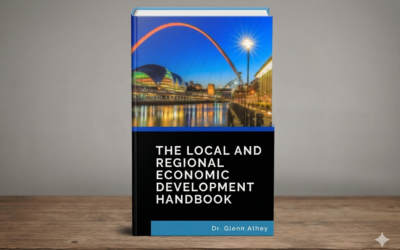
Glowing reviews: A Must Read Handbook for Local and Regional Economic Development
I’ve put out some drafts of The Local and Regional Economic...