

What Actually Drives You Local Economy? The Questions Every Economic Development Practitioner Should Be Asking
There’s a moment most of us in economic development will recognise. You’re sitting in a meeting — perhaps a combined authority board, a regeneration partnership, or a planning committee — and someone asks a deceptively simple question: Why isn’t our economy performing better? The room fills with answers. Skills gaps. Poor transport links. Not enough investment. Too many low-wage jobs. Not enough high-value businesses. The wrong kind of businesses. The usual suspects are rounded up, blamed, and a new initiative is proposed. Another workstream. Another strategy document. Another round of engagement.
But here’s the uncomfortable truth: if you can’t clearly explain how your local economy actually works — the relationships between its component parts, the dynamics that sustain underperformance, the levers that genuinely shift outcomes — then you’re not really doing economic development.
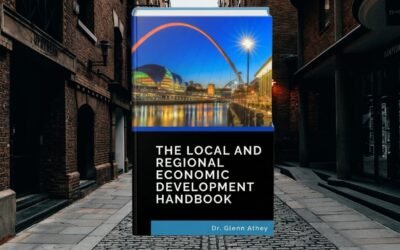
The opening chapters of The Local and Regional Economic Development Handbook set out to challenge this directly. And for anyone serious about the practice — not just the process — of building stronger local and regional economies, they make for essential and sometimes provocative reading.
A Field Defined by Complexity
Local and regional economic development is not a discipline that lends itself to simple frameworks. It is, as The Local and Regional Economic Development Handbook makes clear, a field defined by variety — variety of issues, of contexts, of functions, and of solutions. The range of what economic development practitioners are expected to understand and act upon is genuinely extraordinary: business support and inward investment; skills, employment and labour market policy; land use planning and the built environment; innovation ecosystems and technology adoption; transport and infrastructure; trade and supply chains; sector development; place marketing and tourism; social enterprise and inclusive economy initiatives. The list goes on.
This breadth is often treated as a problem — a sign that the profession lacks focus or coherent identity. But that’s the wrong way to look at it. The breadth exists because economies themselves are diverse, dynamic and deeply complex systems. Economic development has to be broad precisely because the challenge is broad. What it demands, in turn, is that practitioners develop a working understanding of how these different dimensions interact — not necessarily deep expertise in every functional area, but enough fluency to ask the right questions, recognise the connections, and avoid the trap of treating one dimension as if it operates in isolation from everything else.
Economies Are Dynamic Systems — Never Forget It
Perhaps the most important conceptual point in this chapter — and one that The Local and Regional Economic Development Handbook returns to throughout — is that economies are dynamic systems. No single factor or dimension of economic performance operates independently. Business investment is shaped by the availability of skilled labour, which is shaped by the education system, which is shaped by spatial patterns of residence and accessibility, which are shaped by housing markets and transport infrastructure, which are shaped by land use decisions, which are influenced by business location choices, and so on. The chain of interdependence is long, recursive, and often non-linear. The “dynamic” bit means – they consist of moving parts that change. They are not static.
In practice, this means that interventions which address only one part of the system whilst ignoring others are likely to underperform, or to produce unintended consequences elsewhere. The classic case is the business park developed on the edge of town — new floorspace, new investment, potentially new jobs — but without the bus links to connect lower-income workers to those jobs, without the childcare provision that enables parents to take them, and without the supply chain development that might embed the new businesses more deeply in the local economy. Each omission is understandable given resource constraints and organisational boundaries. But the cumulative effect is an intervention that delivers less than it could — and may actually widen existing inequalities.
For those working in combined authorities, LEPs or local councils, this systemic perspective is both intellectually liberating and practically challenging. Liberating, because it legitimises the ambition to work across silos — to connect employment and skills with planning and transport, to link innovation policy with sector development, to join up inclusive economy objectives with inward investment strategy. Challenging, because the organisational and institutional structures within which most practitioners operate fragment these functions across different teams, budgets and governance arrangements. Getting the system to work together requires not just good analysis, but patient relationship-building, institutional trust, and genuine strategic leadership.
What readers are saying about The Local and Regional Economic Development Handbook
“This economic development handbook is a ‘must have’ for anyone in the place-based economic field and provides valuable insights from Glenn’s extensive practical experience which is grounded in strong evidence and research.” Sarah Murray, Chief Executive, Forth Green Freeport.
“If you work in economic development, this will become your go-to resource. I love the practical focus, the case studies and the relentless focus on making lives and communities better.” Adam Breeze, International Expansion Specialist, Director, State of Tennessee for UK & Ireland, Inward Investment Consultant.
The Power of Curiosity
If systems thinking is the conceptual core of good economic development practice, then curiosity is the professional disposition that makes it work. The Local and Regional Economic Development Handbook places real emphasis on this — the ability to ask the right questions, to look beneath the surface of headline statistics, to interrogate received wisdom about what’s holding a local economy back and what might help it to thrive.
This matters more than it might initially seem. Economic development is awash with narratives — about what’s wrong, what works, who’s to blame, what the answer is. Some of those narratives are well-evidenced. Many are not. They persist because they’re politically convenient, because they’re what a particular stakeholder group wants to hear, or simply because nobody has thought to challenge them recently.
The practitioner who asks why — consistently, rigorously, and without assuming they already know the answer — is in a fundamentally stronger position than one who reaches for the familiar intervention or the pre-approved workstream. Curiosity unlocks options. It surfaces evidence that might point in unexpected directions. It identifies the questions that actually need answering before a solution is designed. And crucially, it builds credibility: with partners, with elected members, with investors, and with communities. People trust advisers who clearly understand what they’re talking about — not those who confidently deploy the same toolkit regardless of the problem.
In practice, this means cultivating habits of economic intelligence: regularly reviewing labour market data, business demography statistics, sectoral trends, productivity comparisons, and spatial patterns of growth and decline. It means reading beyond your immediate specialism. It means being willing to say, occasionally, “I don’t know — but I know how to find out.” The Local and Regional Economic Development Handbook is designed precisely to support this kind of professional inquiry, providing practitioners with both the conceptual frameworks and the applied knowledge to think more rigorously about the full range of economic development functions and their interactions.
Everybody Is Doing Economic Development — Whether They Know It or Not
Here is the passage that tends to provoke the most interesting reactions when I share it with practitioners: the recognition that economic development is not something that only economic development teams do. It is happening all the time, through planning decisions, procurement policies, infrastructure investment, school and college provision, transport strategy, housing allocation, licensing decisions, and dozens of other functions that nominally sit in different parts of the organisation entirely.
Behind every high-performing city or regional economy, as The Local and Regional Economic Development Handbook argues, there is typically a capable, well-resourced and strategically coherent economic development function — a team (or network of teams) that understands the local economic system, can articulate a clear theory of change, and has the relationships and influence to align other functions behind shared economic objectives. The presence of that capacity doesn’t explain everything — location, history, connectivity, sector mix and a host of other structural factors all matter enormously. But its absence is consistently associated with weaker outcomes.
This matters because the inverse is equally true: if you do nothing, you are not neutral. Inaction reinforces the dynamics that are already shaping the economy. The structural forces driving underperformance — agglomeration disadvantage, skills mismatches, weak business formation rates, poor infrastructure connectivity, disinvestment cycles in commercial property — do not pause while waiting for a strategy to be written. They compound. The challenge for practitioners, and for the political leaders they support, is to understand that economic development capacity is not an optional extra. It is a core function of any serious local or regional institution.
The gap between this ambition and the reality of resource-constrained local government is, of course, real and often painful. Many economic development teams are stretched thin, covering vast functional territory with small headcounts, managing short-term funding programmes whilst trying to develop long-term strategy, and operating in governance environments that fragment rather than integrate economic functions. Acknowledging this gap honestly is not defeatism — it is the precondition for arguing, credibly and with evidence, for the investment in institutional capacity that better outcomes actually require.
The Long Game: Patience, Institutions, and Realistic Ambition
The final point in this chapter of The Local and Regional Economic Development Handbook is perhaps the hardest one politically: that meaningful change in regional economies takes time. Not years, but often decades.
This is not a counsel of despair. It is a call for realism and strategic patience. The regional economies of northern England, South Wales, parts of Scotland, and coastal communities across the UK did not arrive at their current performance trajectories overnight. They are the product of long-run structural change — deindustrialisation, globalisation, spatial concentration of investment, persistent under-investment in infrastructure and skills — playing out over half a century or more. The idea that a four-year funding programme, or a single round of levelling-up investment, will reverse those dynamics is not a serious proposition. And yet it is the proposition that much of our policy architecture implicitly rests upon.
What genuinely shifts trajectories in lagging regional economies is sustained institutional effort: the same strategic priorities maintained across multiple political cycles; anchor institutions — universities, hospitals, major employers — aligned around shared economic objectives; patient capital deployed in infrastructure and place quality that improves the fundamentals; skills systems rebuilt over time to match the emerging economy rather than the departing one. None of this is glamorous or fast. All of it requires exactly the kind of institutional capacity and long-term thinking that short-term funding cycles and fragmented governance make so difficult.
The challenge for practitioners is to hold this long-term perspective whilst operating in a system that rewards short-term deliverables. It requires a particular kind of professional integrity — the willingness to be honest about what can realistically be achieved in the current funding period, whilst maintaining and communicating a clear sense of the longer journey and what it will require.
Where Do You Go from Here?
The opening sections of The Local and Regional Economic Development Handbook do not offer a magic formula for fixing local economies. What they offer is something arguably more valuable: a rigorous, practice-grounded framework for thinking about the task — one that takes seriously both its intellectual complexity and its human stakes.
The core messages are straightforward even when their implications are demanding. Understand the system, not just the parts. Cultivate curiosity and resist the comfort of familiar narratives. Recognise that economic development is happening across your organisation and your place whether you coordinate it or not. Build for the long term, with the institutional capacity that sustained change requires. And keep asking better questions.
If you work in economic development — in a combined authority, a local council, a LEP, a growth hub, a consultancy, a university, a public body of any kind — these are not abstract principles. They are the foundations of effective practice.
The handbook is available at lredhandbook.com. Whether you are relatively new to the field and looking to build a more rigorous foundation, or an experienced practitioner wanting a framework to sharpen your thinking or develop your team, it is worth your time. Take the ideas in this chapter and hold them up against your own place. Does your economic development function understand the local system well enough? Is it asking the right questions? Is it set up to work across silos and think in decades as well as years? The answers won’t always be comfortable. But they are exactly the right questions to be asking.
—
The Local and Regional Economic Development Handbook is available at lredhandbook.com.
Dr. Glenn Athey is author of The Local and Regional Economic Development Handbook and an advisor and speaker on all things to do with local, regional and city economies. Glenn has held CEO and SMT roles at economic development agencies and has a Ph.D. in Regional Economic Development.
#EconomicDevelopment #RegionalPolicy #LRED